 Marshalr
Every server you run. Every agent you trust. One window.
Marshalr is a workspace over the SSH you already have: terminals, files, git, monitoring and AI coding agents across all your servers, with every risky command waiting for your approval.
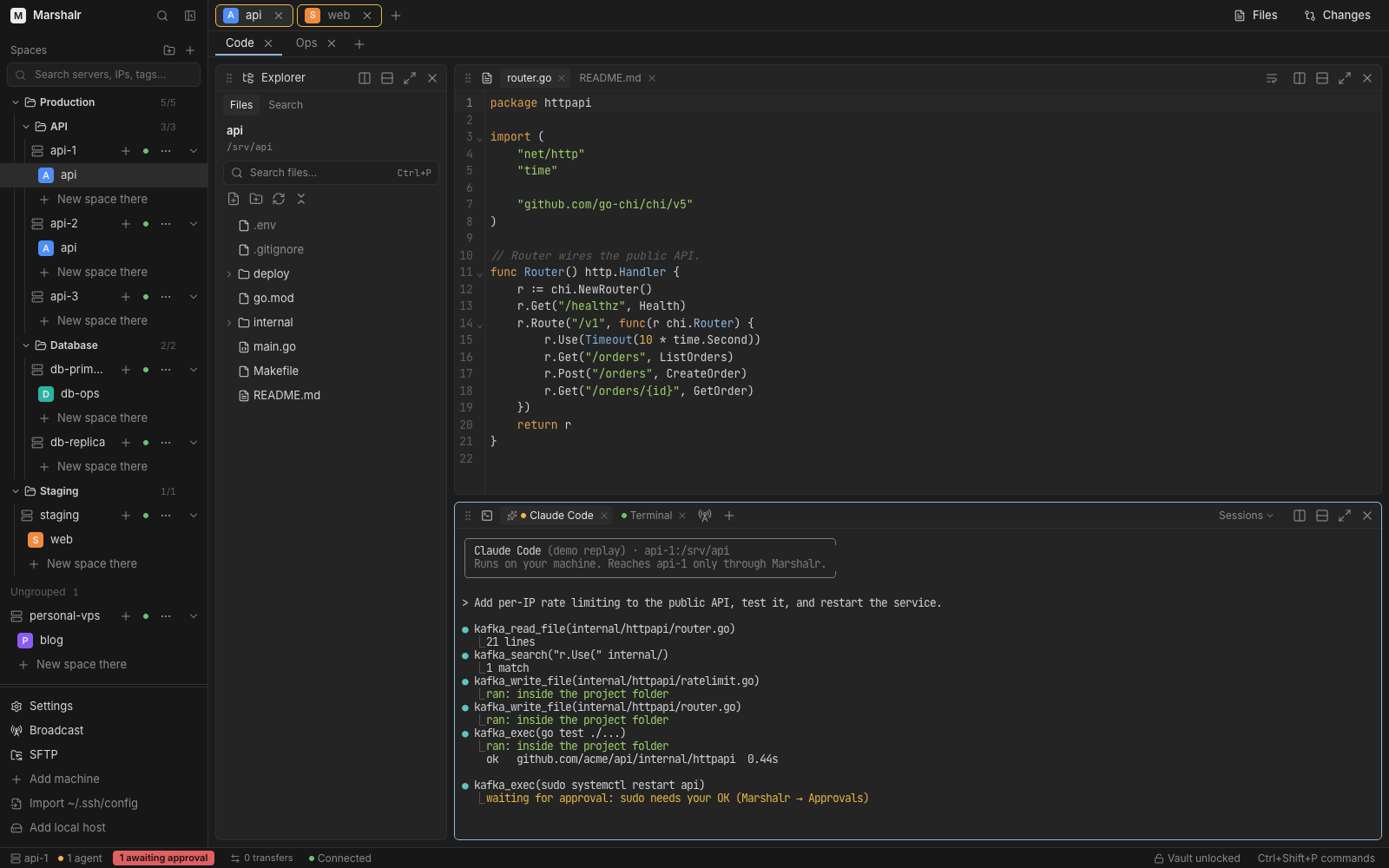
Let agents do the work. Keep your hand on the wheel.
Coding agents are fast, and they are just as fast at rm -rf. Marshalr gives them reach across your servers through tools you control, and gives you the rest of the workspace around them.
Agents without a server-side install
Run Claude Code, OpenCode or any CLI agent on your own machine. It reaches your servers only through Marshalr's tools, over the SSH connection you already trust. Nothing gets installed on the server.
Approval before anything risky
Commands and edits inside the project folder run straight away. sudo, other folders and secret files wait for one click. Every call is logged.
All your servers, organised
Groups and subgroups ("Office → API, Database"), live online counts, and search by name, IP or tag.
Terminals that survive
Sessions keep running after you close the tab. Pick them up again from any device.
Files, editor and git
Explorer, fast quick open, preview tabs, side-by-side diffs, stage, commit and switch branches.
Fleet operations
Broadcast keystrokes to many servers, run runbooks, and copy files between servers over SFTP.
Preview and share
Open dev servers through a private preview, then switch to public to show a client.
Remote desktop
VNC and RDP through SSH tunnels, without opening a single port.
Your laptop runs the agent. Your servers stay as they are.
Start an agent for a project on any server. It works in a folder on your machine, with its local shell and file tools turned off. Every action on the server goes through Marshalr, which checks it against the rules for that project.
- Inside the project folder: builds, tests and edits run without asking.
- Outside it, or with sudo: the request waits in Approvals with the exact command. You can edit it before you allow it.
- Secret files such as
.envand SSH keys stay off limits, and output is redacted.
Built like it holds root, because it does.
Marshalr is self-hosted. Your hub runs on a server or Mac that you control, and it is the only place that ever holds your keys.
- Vault: SSH keys, passwords and scrollback are sealed with Argon2id and XChaCha20-Poly1305 under your master password. While the vault is locked, the hub cannot read them.
- Sign-in: passkeys, TOTP and recovery codes, plus a sudo mode for sensitive actions.
- Every connection verified: host keys are pinned, commands are quoted safely, and each important action goes to an audit log.
- Small attack surface: the hub listens on localhost behind your TLS proxy. No ports are opened on your servers.
Running in about fifteen minutes.
On your own, use the macOS app: everything in one window, no login, and the vault unlocks with Touch ID. For a team, put the hub on a small Linux VPS.
Install
Open the macOS app, or run one deploy command for a Linux hub behind your domain.
Add servers
Use the SSH keys you already have, or import ~/.ssh/config. Group them however you like.
Work, or delegate
Open a project, start a terminal or an agent, and approve what matters.
Join the beta
We are letting in a small group of developers, DevOps engineers and agencies. Tell us a little about your setup and we will email you an invite link.
Questions
Is Marshalr a SaaS?
No. You run the hub yourself, either as the macOS app or on a Linux server. Your SSH keys and data never leave it.
Which agents does it work with?
Claude Code and OpenCode come with presets, and any other CLI agent can run as a custom command. Agents reach your servers through Marshalr's MCP tools.
What do I need on my servers?
Only SSH. Marshalr can deploy a small helper for long-lived sessions, but agents running on your machine don't need anything on the server.
Which platforms are supported?
Servers: Linux, macOS and FreeBSD. Hub: Linux (systemd) or the macOS app. Windows and Linux desktop apps are on the roadmap.
How much does it cost?
The beta is free. Pricing will be announced before general availability, and beta testers will hear about it first.